• ES
  • EN
Fundeps
  • About Fundeps
  • Team
  • Working areas
    • Environment
    • Democracy
    • Gender
    • Global Gorvernance
    • Health
  • News
  • Publications
  • DONATE
  • Click to open the search input field Click to open the search input field Search
  • Menu Menu
News

A Key Year for the Transparency in BNDES
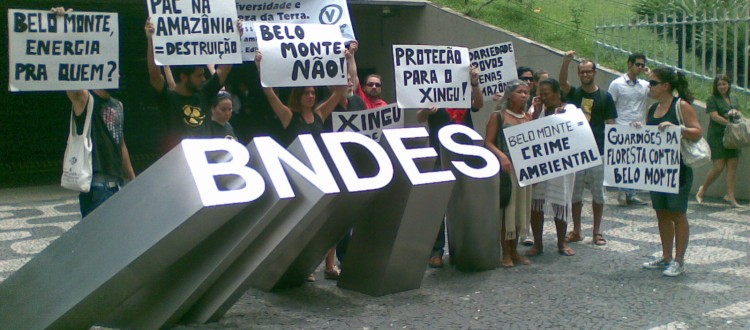
Through the intense internal work done by the Latin American Civil Society in 2013, 2014 appears to be a key year for encouraging transparency and access to information within BNDES and thus aiming to strengthen the regime of socio-environmental safeguards of the Institution.

The Brazilian National Bank for Economic and Social Development (BNDES) constitutes, nowadays, one of the main financial sources of infrastructural work in the Latin American region, Argentina being one of its principal clients. However, the strong growth that the Bank has experienced in its number of activities throughout the recent decades and that it has been allowed to cross the national borders of Brazil with its operations has not come accompanied by the corresponding adjustment in its operational policies and rules of operation to the high standards currently in the Latin American countries, including in International Financial Institutions or multilateral bodies that operate in the region, such as the World Bank, the IADB or the Inter-American Development Bank, among others. At least in terms of socio-environmental safeguards, public participation and transparency; which is an important concern for the Civil Society of Latin America, since a large part of the projects financed by BNDES result in enormous socio-environmental impacts in the territories in which they develop, and the possibilities of participation and of access to information of such projects is extremely limited.

In this context, during 2013 FUNDEPS has worked, alongside a group of Civil Society Organizations (CSOs), as many being Brazilian ones, as ones from the rest of the South American countries, in the effort to clarify the actions and financings of this Institution in the region. Thus, for example, through having participated in various workshops about the operation of BNDES created in the months of June and October 2013 in the city of Rio de Janeiro, FUNDEPS took active participation in the International Workshop of the Civil Society “BNDES’s Agenda: dialogues, convergences and incidence” carried out on the 26th and 27th of November, in the city of Brasilia (Brazil). In this event FUNDEPS presented, alongside other organizations of the region, the document “Guidelines for the Discussion on the Implementation of a Policy of Access to Information for BNDES”, which contains a Model Policy of Access to Information for the Bank and a series of counter-arguments against the reasons alleged by the institution to restrict the information. Both resources have the aim to serve as basic and essential tools for the future incident actions regarding the Organization.

In that regard, 2014 seems to be a key year, since the Bank has decided to open the gateway for dialogue with the Civil Society and to set up an institutionalized space for discussion with the SCOs, where different subject matters concerning the operation and functioning of the Organization are addressed. The first of these meetings, agreed on for February of 2014, will approach the subject of Transparency and Access to Information within BNDES fairly, which with a doubt forms a unique opportunity to work alongside the Bank with a view to perfect its regime of transparency and access to information. The bad news is that this space will be restricted, at least for the moment, to Brazilian organizations only, without participation of the rest of the organizations in the region. Despite this impediment, FUNDEPS will continue working throughout 2014 in the effort to make the actions of BNDES clear and ensure that the Bank adopts an appropriate Policy of Access to Information, a prerequisite to be able to effectively influence the strengthening of the socio-environmental safeguards applied to the projects financed by the Institution.

Resource:

Document of Work – Transparencia en el BNDES. Una agenda de desarrollo. (Transparency in BNDES. A Development Agenda)

Contact:

Gonzalo Roza – Coordinator of the Global Governability Programme

gon.roza@fundeps.org

Translated by: Max Jeremiah

21 de January de 2014
Tags: Global Governance
Share this entry
  • Share on Facebook
  • Share on X
  • Share on WhatsApp
  • Share on LinkedIn
  • Share by Mail
https://fundeps.org/wp-content/uploads/2017/06/BNDES-1.jpg 330 750 Fundeps.org https://fundeps.org/wp-content/uploads/2026/04/logo-2026-300x120.png Fundeps.org2014-01-21 16:25:102024-06-30 16:04:16A Key Year for the Transparency in BNDES
You might also like
Claim for higher standards of protection of DD.HH. in infrastructure megaprojects
What is the Green Climate Fund and how does it work?
Bogotá: Workshop on Mechanisms for Accountability and Civil Society
With the trunk pipelines concluded: positive or negative balance?
The First Finance in Common Summit was held, which brought together the world’s public development banks
The responsibility of accountability mechanisms to protect human rights: ICIM Case
Virtual meetings on Gender and International Financial Institutions
The incorporation of Argentina to the Asian Infrastructure Investment Bank was approved

Tags

Access to Information Access to Justice BID Chinese Investments Citizen Participation Democracy ENTs Environment Environmental Democracy Gender Global Governance Health Healthy nutrition IFIs Infrastructure Financing Legal Interruption of Pregnancy Sexual and Reproductive Rights Social and Environmental Standards Tobacco Control Transparency
See all tags

Acuerdo de Escazú

Emergencia Agroquímica

MOCI - monitoreo ciudadano en proyectos de infraestructura

{el entramado} Contamos historias. Acercamos Realidades.

Instagram

fundepsargentina

Trabajamos para que se garanticen los derechos humanos 🌱⚖️🗣️🌈💜🚭🍎
Promovemos la equidad de #genero, el derecho a la #salud y un #ambiente sano.

Y todo esto quedó en un papel? No. Ya hay avances. Y todo esto quedó en un papel? No. Ya hay avances. Pero tampoco está resuelto.

Hay plantas de tratamiento que comenzaron a funcionar, obras de cloacas terminadas y establecimientos que fueron auditados por posible contaminación.

➡️ También quedan medidas por cumplir y avances que necesitan seguimiento. Porque mostrar lo que se hizo también sirve para saber qué falta.

Para seguir acompañando este proceso y sosteniendo el trabajo que todavía queda, necesitamos tu apoyo.

Doná hoy.
La Justicia no solo dijo que el lago está contamin La Justicia no solo dijo que el lago está contaminado. También ordenó qué tiene que hacer el Estado para empezar a sanearlo.

La sentencia establece medidas concretas, con plazos y obligaciones que involucran a la Provincia y a los municipios de la cuenca.

Entre ellas: avanzar con las obras cloacales, controlar los vertidos contaminantes, fortalecer la fiscalización y garantizar espacios de participación y transparencia.

Deslizá para conocer qué tiene que pasar para que el saneamiento avance.

Ayudanos a seguir trabajando para que estas medidas se cumplan. Doná hoy.
Hoy, 4 de septiembre, es el Día Mundial de la Salu Hoy, 4 de septiembre, es el Día Mundial de la Salud Sexual. Una fecha que nos invita a volver sobre las discusiones que atraviesan el acceso a la salud sexual y (no) reproductiva: condiciones de acceso para que sea integral y de calidad, desde un enfoque de derechos y con perspectiva de diversidad.

En el mes de junio nos encontramos en el 3° Encuentro Provincial de Redes de Compromiso y Cuidados: Salud sexual Integral con Perspectiva de Diversidad para poner en común experiencias y preguntas sobre estos desafíos.

Hoy recuperamos algunas de las voces que fueron parte de las exposiciones de ese encuentro para volver sobre dos preguntas que siguen abiertas:
¿Cuál es hoy el debate más urgente cuando hablamos de salud integral y diversidad?
¿Por qué es importante encontrarnos en este contexto?

Porque garantizar el derecho a la salud también implica seguir encontrándonos para pensar, discutir y construir respuestas colectivas.
🕰Han pasado 84 años… y seguimos hablando del Lago 🕰Han pasado 84 años… y seguimos hablando del Lago San Roque.
Bueno, no tanto. Pero sí llevamos más de cuatro años trabajando para que el saneamiento de la cuenca deje de ser una promesa y se convierta en una realidad.

En 2022 presentamos un amparo colectivo junto a la comunidad de la cuenca. En abril de 2025, la Justicia reconoció el daño ambiental y ordenó sanear el lago.

❗¿El problema? Un fallo no alcanza por sí solo. El Plan de Saneamiento ya está en marcha y todavía queda mucho por hacer.

En este carrusel te contamos qué pasó y por qué seguimos hablando del Lago San Roque.

Si querés que este trabajo continúe, podés sumarte con una donación. [link en bio]
Follow on Instagram

Twitter

Tweets por @fundeps

Newsletter Subscription

    Fundeps. Córdoba (CP X5000JZH), Argentina. info@fundeps.org
    • Link to X
    • Link to Facebook
    • Link to Instagram
    • Link to Mail
    • Link to Youtube
    • Link to LinkedIn
    • Link to TikTok
    Link to: Lineamientos para la Discusión. Implementación de una Política de Acceso a la Información para el Banco Nacional de Desarrollo Económico y Social de Brasil (BNDES) – January 2014 Link to: Lineamientos para la Discusión. Implementación de una Política de Acceso a la Información para el Banco Nacional de Desarrollo Económico y Social de Brasil (BNDES) – January 2014 Lineamientos para la Discusión. Implementación de una Política de Acceso... Link to: Residents of Alta Gracia File Court Papers in Support of the Constitutionality of Environmental Protection Zones Link to: Residents of Alta Gracia File Court Papers in Support of the Constitutionality of Environmental Protection Zones Residents of Alta Gracia File Court Papers in Support of the Constitutionality...
    Scroll to top Scroll to top Scroll to top