Advances and challenges at the Villa Carlos Paz Environmental Center Project
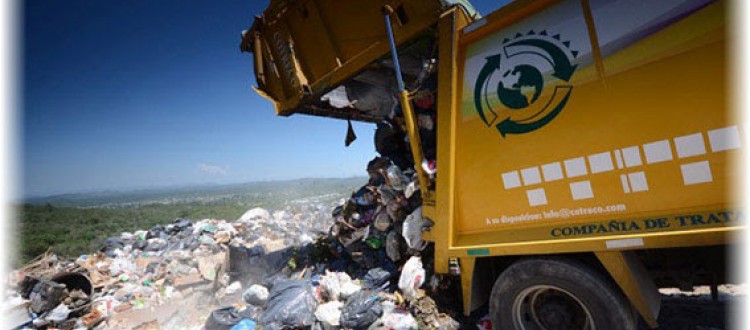
Administrative processes are advancing and it is expected that in May 2017 work will begin for the construction of the Villa Carlos Paz Environmental Center with financing from the Inter-American Development Bank.
“Below, we offer a google translate version of the original article in Spanish. This translation may not be accurate but serves as a general presentation of the article. For more accurate information, please switch to the Spanish version of the website. In addition, feel free to directly contact in English the person mentioned at the bottom of this article with regards to this topic.”
The IDB’s Integrated Urban Solid Waste Management Program (GIRSU) finances works for the integral management of solid urban waste and the recovery of degraded areas due to the poor disposal of such wastes. The total cost of the program is US $ 150 million and contains two subprograms: on the one hand, GIRSU in national parks and adjacent municipalities and, on the other hand, GIRSU in other tourist municipalities.
Within the second group is the Villa Carlos Paz Environmental Center. The center was designed to receive the urban solid waste from five neighboring municipalities that agreed with the municipal administration of Carlos Paz their joint treatment. The project was developed by TecnoMak S.A. Contracted by the Executing Unit of International Loans under the Ministry of Tourism of the Nation.
TecnoMak S.A. Studied three alternatives for possible locations of the new MSW treatment center. Finally, it was decided to locate it in the building of the current open-air garbage dump bordering the La Calera Natural Reserve.
The project has three groups of works:
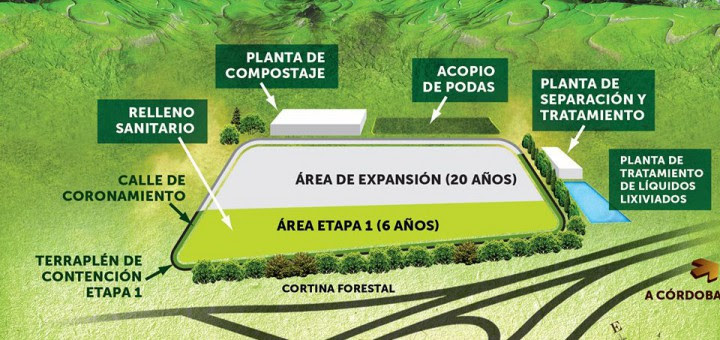
Works Group 1: Sanitary Landfill for the disposal of MSW generated in the localities of the Municipality of Villa Carlos Paz and communes of the area of influence of the project; With a useful life of 20 years and an average daily income of 163 Tn / day.
Works Group 2: Separation and Treatment Plant and related logistical and administrative support works.
Works Group 3: Closing and Closing of the Landfill to Open Sky currently existing.
On April 7, 2016, the environmental public hearing was held in which the authorities participated and eleven people registered with it.
The mayor Esteban Avilés explained:
“We are working on a regional project that will give us a definitive solution to the open dump (…), with this public hearing would be closed the administrative situation and then move to the instance of decrees that have to do with the Secretariat of Environment Of the province, and the Ministry of Tourism of the Nation by Gustavo Santos”
Regarding the deadlines stated that “we believe that we will be fairly quick compared to other projects approved at the national level” but did not rule out before the end of the year.
Several objections were raised by María Luz Cammisa (Secretary of the Norman Morandini, Director of the Human Rights Observatory of the Senate of the Nation), related to the relevance of the hearing as “it arrives with a work that is tendered and has been up to Pre-awarded (…) We are here in some way to validate what has already been decided by us” It was also stressed the jurisdictional limitation, since the affected lands are outside the ejido of Carlos Paz:
“It is for us a priority issue that I raised to the governor Juan Schiaretti because we can not advance in a planning with the intermediate institutions of the city always being conditioned to that the province resolves this administrative situation.I see that it is a governor that has this type De la Sota really had no interest for anything, “declared the Intendente and later be endorsed by his collaborators: It is a theme of substance for the Carlospacenses; But that does not determine the continuity of the project.”
More controversial was the mention of Cammisa regarding the deadline stipulated by the Technical Commission for the use of the module:
“…it must have a maximum of six years, and that after the same period, a site outside the San Roque basin (…) should be used to specify the integration of a Comprehensive Waste Management Program in the metropolitan area of Córdoba (CORMECOR) “(…) We do not know if the municipality itself will have a solution for its waste beyond six years. That is to say that the projected environmental center will last less years than the time taken to plan it”
Those who responded to this were the architect Liliana Bina and the secretary of Urban Environmental Development, Horacio Pedrone. They mentioned in this respect that the Interdisciplinary Technical Commission suggested this term in view of the CORMECOR project, of which the city would participate if it materialized. However, “this plant would continue to function exactly the same, but instead of throwing the surplus into the sanitary burial, we would do it in a transfer iron to Cordoba.” Meanwhile, Villa Carlos Paz as the member communes will have buried for that date some 475 thousand tons of garbage.
On the other hand, Pedrone said “to say that the municipalities and communes that have signed intermunicipal agreements with us and that they will not be able to throw the garbage more is absolutely false … The project has been thought from the first minute with the participation Of the eight municipalities and municipalities bordering Villa Carlos Paz and have always treated the subject of garbage together” said in a framework of participation in which were present the community leaders Andrea Jordán (Cuesta Blanca), Adolfo Parizzia (Estancia Vieja) and representatives of Icho Cruz and Cabalango.
Other approaches were related to the territorial organization of the native forest:
“… there is no mention in the environmental impact study of the negative impacts of the reserve. It is an area bordering a protected area, and a project that seeks to be authorized by means of exceptions provided for in the Forests Law (…) The opinion of the Technical Commission itself warns against the location of the project that it would be inadvisable to concentrate in this area more potentially impacting installations against the environment, since it is in the vicinity of the natural area (…) and in areas with drainage at Lake San Roque.”
This point was also raised by environmentalist Juan Carlos Paesani, who for health reasons was not present but made read his statement: “Will it be understood that this reservoir gives drinking to almost two million people in the city of Córdoba? Continue to ignore elementary principles.”
More confrontational was the speech of the President of the Council of Representatives, Walter Gispert, who retorted the remarks when pointing out that:
“Apart from saying, we have to do, our government has spoken to everyone … Beyond the technical issues, the material and environmental debt that the city has and the effort made by all public and private institutions to Solve the problem, for our future, I ask you to approve the project.”
He also suggested that “the Chicana” comes from a member who shares his same political space, Norma Morandini, “whom I spoke to personally to raise the situation, but he never came to Carlos Paz, and she was a legislator for Córdoba.”
In August, the national public bidding process was carried out and in November the tenders for the international public tender were opened. The works will start in May 2017. The current landfill will be replaced by a landfill that will house a waste separation plant and a recycling plant. 222 million will be financed by the Inter-American Development Bank and it is estimated that the work will require around eight months and that by mid-2018 this new plant would be put into operation.
From FUNDEPS we follow these processes to ensure that they respect human rights and the environment. The location of the Villa Carlos Paz Environmental Center next to the La Calera Defense Nature Reserve, and meters away from San Roque Lake on land that may have a higher propensity to seep or leach into the water, is questionable. In this context of possible environmental and social impacts, the municipal and provincial governments must ensure the highest levels of transparency and access to information. From FUNDEPS we will monitor compliance with provincial and national regulations on these issues as well as compliance with the corresponding operational policies of the IDB.
More information
- Norman Morandini Report: “Cordoba and its unprotected areas”
- Public Hearing Report
- Carlos Paz: “Open pit” landfill would stop working in just two years
Contact
Gonzalo Roza, gon.roza@fundeps.org