Gender parity: a necessary conquest

On November 23, 2017, the National Congress approved Law No. 27,412 on Gender Parity in Areas of Political Representation, the result of the harmonization of several projects presented in the Senate during 2016. The first one was the one presented on February 26 of that year by Peronist deputy Jujeña Liliana Fellner.
“Below, we offer a google translate version of the original article in Spanish. This translation may not be accurate but serves as a general presentation of the article. For more accurate information, please switch to the Spanish version of the website. In addition, feel free to directly contact in English the person mentioned at the bottom of this article with regards to this topic”.
Although the final draft had been approved in the Senate in October 2016, it did not reach the Chamber of Deputies until shortly before the end of the 2017 session.
In the long session on November 22, Rep. Victoria Donda (Movimiento Libres del Sur) asked that the project be treated “on tables”. Thus, in the early hours of the morning, with 165 votes in favor, 4 votes against, 2 abstentions and 82 absent deputies, the bill became law.
With the aim of guaranteeing gender parity in the legislative bodies, the law establishes that the lists of candidates for the National Congress (deputies and senators) and the Mercosur Parliament must be carried out “placing interspersed women and men from the first titular candidate to the last alternate candidate”.
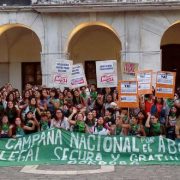
In this way, the law takes female representation on the electoral lists to 50 percent, guaranteeing the principle of gender equivalent participation. This decision is in tune with the local legislation of some provinces, such as Santiago del Estero, Córdoba, Río Negro and, more recently, Buenos Aires, which for several years now have laws of equivalent gender participation.
The Law of Quota: the fundamental antecedent
Although we had a quota law since 1991, the year in which Argentina became the first country in the world to guarantee the participation of women in electoral posts, this law was already obsolete. Law 24,012, which two decades ago was considered advanced, established a minimum quota of 30% that should be occupied by women. However, in practice, the law ended up showing its limitations when converting that percentage into a ceiling, rather than a minimum quota, causing women to be relegated to third, sixth or ninth place in the lists.
Unfortunately, as we have said on another occasion, in the swing of the interpretation of our National Constitution, and in particular Art. 37, the provisions of the Convention for the Elimination of All Forms of Discrimination against Women continue to be ignored. (CEDAW, for its acronym in English), which enjoys constitutional status and must be mandatorily taken as a current and complementary rule of our Constitution.
The CEDAW, in its Art. 4 Inc. 1, provides: “The adoption by States Parties of temporary special measures aimed at accelerating de facto equality between men and women shall not be considered discrimination in the manner defined in the present Convention, but in no way entail, as a consequence, the maintenance of unequal or separate regulations; these measures will cease when the objectives of equality of opportunity and treatment have been reached.”
The female quota laws are nothing other than these “temporary special measures” established in this normative body, which must cease when the objectives of equality of opportunity and treatment have been reached.
Already at the last Conferences on Women in Latin America and the Caribbean, the idea of a minimum percentage for gender parity had been proposed as a regional goal. In the Quito Consensus emerged from the X Regional Conference on Women States recognized that parity is “one of the determinant drivers of democracy, whose goal is to achieve equality in the exercise of power, in decision-making, in the mechanisms of participation and social and political representation, and in the family relations within the different types of families, the social, economic, political and cultural relations, and that constitutes a goal to eradicate the structural exclusion of women“.
The quotas are corrective measures and, therefore, temporary; On the other hand, parity is a permanent principle that better represents equality in the exercise of power. Parity is a definitive measure that seeks to share the political power between women and men and transform the very idea of democracy.
However, it is necessary to recognize that the quota laws or quota mechanisms have achieved conquests on the road to equality, favoring new issues on the public agenda, especially in terms of gender equality and defense of rights.
Since then, our Congress has enacted numerous laws that promote the rights of women against discrimination and inequality that they suffer for reasons of gender, such as Law 26,485 of Comprehensive Protection to prevent, punish and eradicate violence against women in the areas of that develop their interpersonal relationships (2009), Law 26,522 of Audiovisual Communication Services (which promotes equal treatment and not stereotyped in the media, avoiding discrimination based on gender or sexual orientation, also in 2009), Law 26,862 of Comprehensive access to medical-assistance procedures and techniques of medically assisted reproduction (2013) and Law 26,873 of Breastfeeding – Public Promotion and Awareness (2013), to name a few.
As a result of the long struggle of the different feminist movements and the work of legislators of different party colors, parity represents an enormous advance in legislative matters. This advance, however, must be accompanied by public policies with a gender perspective that guarantee and deepen the realization of these rights and that contribute to a real transformation of patriarchal power relations.
The Gender Parity Law in Areas of Political Representation is definitely a positive measure that will allow the effective enjoyment of women’s human rights and the real opening of the legislative space to the agenda of the feminist movements as inescapable themes for the strengthening of the democracy.
Authors
Rocío Aguirre
Mayca Balaguer
More information
Virginia Pedraza – vir.pedraza@fundeps.org
Mayca Balaguer – maycabalaguer@fundeps.org
Emilia Pioletti – emiliapioletti@fundeps.org