• ES
  • EN
Fundeps
  • About Fundeps
  • Team
  • Working areas
    • Environment
    • Democracy
    • Gender
    • Global Gorvernance
    • Health
  • News
  • Publications
  • DONATE
  • Click to open the search input field Click to open the search input field Search
  • Menu Menu
Global Governance, News

Moving towards a binding treaty on transnational corporations and human rights
“Below, we offer a google translate version of the original article in Spanish. This translation may not be accurate but serves as a general presentation of the article. For more accurate information, please switch to the Spanish version of the website. In addition, feel free to directly contact in English the person mentioned at the bottom of this article with regards to this topic”


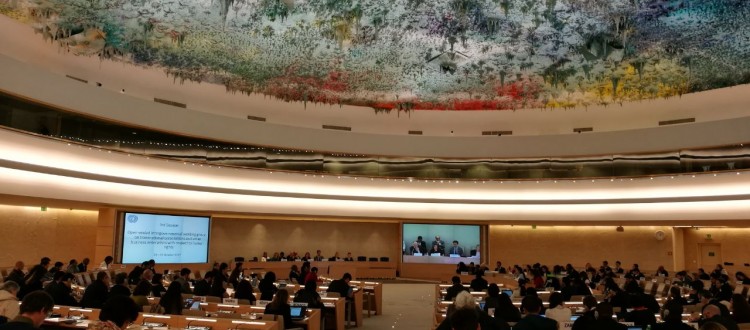
The idea of ​​moving forward in an international instrument that responds to the regulatory challenges generated by the actions of international companies is taking on a new impetus in 2013, based on the initiative of a group of countries from Latin America, Asia and Africa. From the identification of numerous cases of human rights violations by transnational corporations, it was decided to create a space that would allow the debate on the creation of a legally binding instrument. The statement made at that time highlighted that:

The growing number of cases of human rights abuses and violations committed by transnational corporations remind us of the need to move towards a legally binding framework to regulate the work of transnational corporations and to provide adequate protection, justice and reparations to victims of transnational corporations. abuses against human rights, related to the activities of certain transnational corporations and other enterprises.

So far, the legal framework regulating the activities of international companies has been summarized in non-binding instruments and mechanisms: among them the UN Guiding Principles on Business and Human Rights, the OECD Guidelines and the UN Working Group on companies and human rights. Such instruments have limited powers to monitor companies’ compliance with the Principles and only provide a partial response to urgent issues related to human rights abuses by transnational corporations. These principles and mechanisms do not adequately respond to the regulatory challenges of actors such as international companies. In addition, they fail to secure access to justice in the face of actions by transnational corporations that have an impact on human rights or to ensure adequate reparations for victims.
Resolution 26/9, established by the United Nations Human Rights Council on 26 June 2014, created the Working Group mandated “to develop a legally binding instrument to regulate the activities of transnational corporations and other enterprises in international human rights law“.
An international legally binding instrument, adopted within the United Nations system, would make clear the obligations of transnational corporations, both in the field of human rights and in the face of States. It would also allow for fair reparations for victims in cases where it is clearly impossible to effectively prosecute companies with domestic legislation.

Meetings were held in the years following the formation of the intergovernmental group (2015 and 2016) to further advance the treaty negotiations. In 2017, the third session of the group was held, seeking to outline a possible textof the legally binding instrument.

During the course of the first two sessions both civil society organizations and participating States stressed that:

– The Guiding Principles on Business and Human Rights did not address the core of the debate on maximum protection of human rights and access to justice and redress.

– Any binding instrument should clearly establish the obligation of transnational corporations to respect environmental, health and labor standards and international humanitarian law.

– The gender perspective was requested to be incorporated into the instrument, as human rights violations committed by transnational corporations could accentuate previous inequalities and have negative gender consequences.

– It was noted that the working group process was related to the implementation of Agenda 2030 for Sustainable Development.

– International financial institutions could also be included in the scope of the instrument, which would be consistent with international law.

– The size of the companies to which the treaty should apply was discussed, taking into account the activities of all companies, but focusing on transnational corporations.

– NGOs agreed to recognize the principle of human rights hierarchy in other areas of international law, in particular the rules on trade and investment protection.
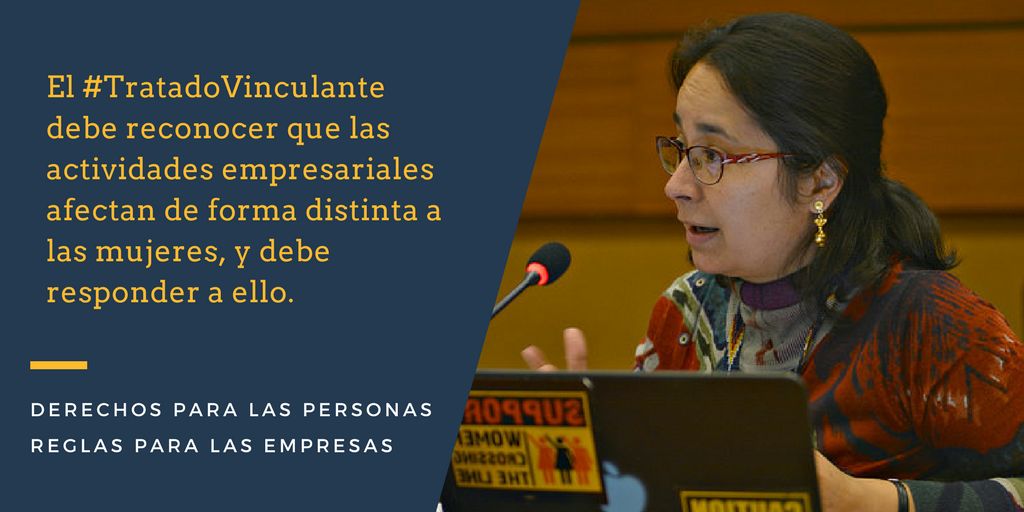
For the 2017 session civil society has sought to achieve greater commitment on the road to the creation of the treaty. Numerous organizations and social movements are driving the generation of this instrument to finally achieve better levels of accountability on the part of transnational corporations. Groups such as Stop Corporate Impunity and Treaty Movement have been involved in trying to incorporate the vision of civil society organizations into the text of the treaty. In addition, the G77 + China Group, in its Ministerial Declaration of 2017, emphasized the importance and acceptance of a binding treaty; and urged Member States to participate in the third session to be held in Geneva.

In contrast, the International Business Community has emphasized that the elements to be included in the treaty proposed by the Intergovernmental Group represent a ‘setback on the commitments assumed from the Guiding Principles’. In this regard, it was emphasized that the almost exclusive approach in transnational corporations does not take into account the serious human rights violations caused by the actions of national companies. Likewise, it stresses that the creation of a legally binding instrument removes the power of States, and even underestimates them, when enforcing the current regulations. In addition, the need to strengthen state institutions is emphasized rather than embarking on the creation of such an instrument.

Since the creation of the Intergovernmental Working Group, the debate has focused on the need to define the approach of the treaty. Civil society has stressed the urgent need to involve transnational corporations, while the corporate community and the states of the European Union plus the United States have rejected this perspective.

The role of Argentina in the face of the discussion

Argentina’s position on this issue has not been entirely clear. During the management of Cristina Fernandez, the decision was to abstain in the vote to try to create the binding instrument. However, under the management of Mauricio Macri, there was no formalisation of a position. However, following a request for access to information to the Ministry of RREE and Worship, a response was received which showed that the Argentine Republic shares the growing interest of the international community in linking corporate responsibility with respect to human rights. In the same way, it maintains an active commitment with the initiatives aimed at raising the standards in this matter.

In this sense, it should be mentioned that it seems that Argentina is positively inclined towards this initiative. It is also worth noting that in the middle of this year a first version of a National Action Plan for the application of the Guiding Principles on Human Rights and Business was presented.

During the remaining days of the third session, the debate will continue on the generation of a binding instrument and we hope that the result will be a substantive advance regarding the obligations of companies to respect and guarantee human rights. Likewise, we hope that Argentina will assume a position of support for this initiative and that in that process it will allow the participation of civil society organizations and in particular of communities that have been impacted by the actions of transnational corporations.

Author

Agustina Palencia, agustinapalencia@fundeps.org 

Contact

Juan Carballo, juanmcarballo@fundeps.org
25 de October de 2017
Tags: Human Rights and Companies
Share this entry
  • Share on Facebook
  • Share on X
  • Share on WhatsApp
  • Share on LinkedIn
  • Share by Mail
https://fundeps.org/wp-content/uploads/2018/01/img-20171023-wa0007-1.jpg 330 750 Fundeps.org https://fundeps.org/wp-content/uploads/2026/04/logo-2026-300x120.png Fundeps.org2017-10-25 20:36:182024-06-30 16:03:12Moving towards a binding treaty on transnational corporations and human rights
You might also like
Summary of the report ‘Business and Human Rights: Inter-American standards’
We invite you to the National Forum of Gender Policies in Journalism and Advertising
9th Annual Forum on Business and Human Rights
We participate in the Spring Meetings of the World Bank 2017
Civil Society Organizations’ critics to bank interpretations on human rights responsibilities
Effective access to reparation measures at the center of the debate of the 6th United Nations Forum
Worrying situation of human rights defenders worldwide
Revocation of the order to carry out studies on environmental contamination in Porta Hnos.’s case

Tags

Access to Information Access to Justice BID Chinese Investments Citizen Participation Democracy ENTs Environment Environmental Democracy Gender Global Governance Health Healthy nutrition IFIs Infrastructure Financing Legal Interruption of Pregnancy Sexual and Reproductive Rights Social and Environmental Standards Tobacco Control Transparency
See all tags

Acuerdo de Escazú

Emergencia Agroquímica

MOCI - monitoreo ciudadano en proyectos de infraestructura

{el entramado} Contamos historias. Acercamos Realidades.

Instagram

fundepsargentina

Trabajamos para que se garanticen los derechos humanos 🌱⚖️🗣️🌈💜🚭🍎
Promovemos la equidad de #genero, el derecho a la #salud y un #ambiente sano.

Este viernes 31 de julio realizamos un nuevo encue Este viernes 31 de julio realizamos un nuevo encuentro de formación en derechos sexuales y (no) reproductivos. 

En articulación con el Consultorio de Salud Integral y con el aval de la DAJA, compartimos la jornada de capacitación con profesionales del Hospital Vicente Agüero de Jesús María.

Más de 15 profesionales de diversas disciplinas se dieron cita, para conocer diferentes aspectos de la práctica de AMEU y fortalecer su trabajo diario, en pos del acceso al aborto legal, seguro y gratuito.

Como en cada instancia, celebramos el compromiso de cada participante y agradecemos especialmente a la Dra. Kenia Torres y al Director del Hospital, Dr. Javier Díaz, por la predisposición para recibirnos.
La información como herramienta ya está disponible La información como herramienta ya está disponible en Aprender con Fundeps.

Aprendé a ejercer el derecho de acceso a la información pública y a usarlo para defender derechos, monitorear decisiones e impulsar procesos de incidencia.

En este curso vas a aprender:

📌 Cómo hacer solicitudes de acceso a la información pública.
📌 Qué hacer cuando un organismo no responde.
📌 Cómo acceder a información sobre proyectos financiados por organismos internacionales.

💻 Curso virtual, gratuito y autoadministrado.
🔗 Inscribite en aprender.fundeps.org
🌎 Hace un año, la @corteidhoficial emitió su histó 🌎 Hace un año, la @corteidhoficial emitió su histórica Opinión Consultiva sobre la emergencia climática.

✊ Una victoria para quienes defienden el ambiente en América Latina y el Caribe: la Corte confirmó que proteger a las personas defensoras del ambiente no es opcional. Es una obligación legal.

⚖️ Para explicar qué exige esa protección, la Corte se apoyó en el Acuerdo de Escazú. Resultado: la gran mayoría de Estados de América Latina y el Caribe no pueden ignorar los estándares de Escazú, incluso si aún no han ratificado el tratado.

🔎 La implicación es clara: los países de la región deben fortalecer el acceso a la información, la participación pública, la justicia ambiental y la protección de quienes defienden el ambiente. 

📝 La Opinión abre nuevas rutas para frenar la criminalización de personas defensoras, responder a las restricciones al espacio cívico y defender la participación pública en países como Costa Rica, Guatemala y Perú. Compartimos el análisis de  @manizalmigrante del @ciel_org

📣 La discusión ya no es si los países de América Latina y el Caribe deben proteger a quienes defienden el ambiente. Eso ya está claro. Ahora hay que usar la Opinión: en tribunales, reformas, debates públicos y procesos de movilización para exigir mejores garantías y mayor protección.

🔗 Lee el análisis completo en el link en www.ciel.org/corte-idh-escazu-personas-defensoras/
Seguimos compartiendo algunos momentos del 3° Encu Seguimos compartiendo algunos momentos del 3° Encuentro Provincial de Redes de Compromiso y Cuidados 🧡

Creemos que no hay mejor manera de cerrar una jornada de formación, intercambio y construcción colectiva que encontrándonos también desde el arte. Porque la música y la poesía también nos invitan a imaginar otros mundos posibles.

Así vivimos Revuelo Sur, Íntimas, el espectáculo de Susy Shock junto al Dúo Bazán-Bonillo, que acompañó el cierre de este encuentro.

Gracias a todas las personas que se acercaron y fueron parte de esta jornada.
Follow on Instagram

Twitter

Tweets por @fundeps

Newsletter Subscription

    Fundeps. Córdoba (CP X5000JZH), Argentina. info@fundeps.org
    • Link to X
    • Link to Facebook
    • Link to Instagram
    • Link to Mail
    • Link to Youtube
    • Link to LinkedIn
    • Link to TikTok
    Link to: Global Meeting of the Coalition for Human Rights in Development Link to: Global Meeting of the Coalition for Human Rights in Development Global Meeting of the Coalition for Human Rights in Development Link to: 32nd National Meeting of Women: a movement that resists Link to: 32nd National Meeting of Women: a movement that resists 32nd National Meeting of Women: a movement that resists
    Scroll to top Scroll to top Scroll to top