With the trunk pipelines concluded: positive or negative balance?

In January 2019, and after more than 10 years since the project began to be planned, the Government of the Province of Córdoba terminated the works of the trunk gas pipelines. Despite the obvious benefits of the project, it is worth asking about the true balance left by the experience of this project, especially in terms of transparency and accountability in public policies.
“Below, we offer a google translate version of the original article in Spanish. This translation may not be accurate but serves as a general presentation of the article. For more accurate information, please switch to the Spanish version of the website. In addition, feel free to directly contact in English the person mentioned at the bottom of this article with regards to this topic”.
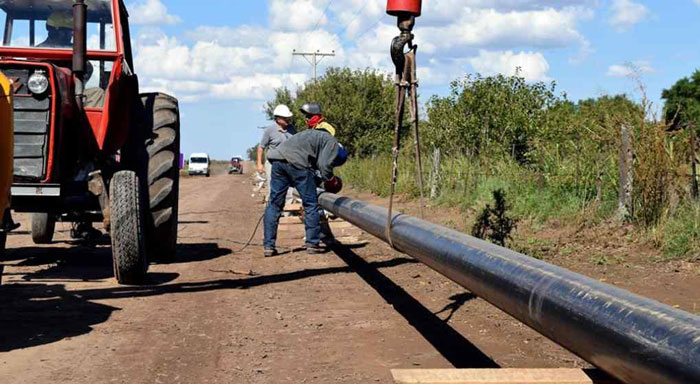
At the beginning of 2019, with the authorization of the last supply branch and the pressure regulating plant in Tala Cañada (Pocho), the Government of the province of Córdoba concluded the controversial project for the construction of the trunk pipeline network. According to the government, the gas network thus reached almost 98% of Cordoba people; Although it is clear that the vast majority of industries and neighbors benefiting from the work do not yet have effective access to the service, since the problem of connecting to home and internal networks remains to be resolved.
With the work completed, the axis then moved to the need to connect the backbone networks with the home networks, so that families and businesses can effectively access the benefit. The company Ecogas and the municipalities are responsible for bringing the gas network to private homes, for which they will receive financial support from the province. While the Bank of Córdoba made available a line of credit -Dale Gas! – at zero interest rate and with a return of 48 months for the home gas installation; The provincial government launched a financing plan so that companies can connect to the network. This plan called «Connect Gas Industry» contains three lines of credit for businesses, SMEs, industrial parks, CNG stations and tourist establishments.
A controversial work
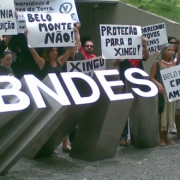
This work, according to data handled by the provincial government, benefits 973,490 Cordoba in 228 locations. Some populations will receive natural gas for the first time and, in other locations, the service will reinforce the existing one. However, despite the obvious benefits of the work, the project of gasification of towns in the interior of the province of Córdoba has been the focus of various controversies and has been under the watchful eye of public opinion since its inception. Thus, for example, as regards the financing of the work, the reasons for the fall in financing of both BNDES at first, and of Chinese banks later, were never officially clarified; and the provincial government’s decision to move forward with the work using public indebtedness generated controversy.
Similarly, the lack of access to information to control the progress of the project has been a constant throughout the entire execution process. Additionally, the project has been investigated for alleged acts of corruption in the bidding of the sections to be built, even being mentioned in the Lava Jato case in Brazil from the participation of the Odebrecht company in the works.
Thus, for example, in February 2018, the legislators of the opposition to the provincial Government, Juan Pablo Quinteros, Aurelio García Elorrio and Liliana Montero, filed a complaint with the Financial Information Unit (FIU) regarding the possible payment of charges for the work of the trunk pipelines. This follows from the kidnapping of the list of coimas paid to different governments of the continent belonging to the Brazilian banker Alberto Youssef, where he names at least four times the work in question. This list served as a tool for Brazilian investigators of the Lava Jato cause to prove the existence of a public works club made up of Odebrecht, Andrade Gutiérrez, OAS, Camargo Correa and other construction companies. According to the complainants, a 36 million dollar premium would have been paid. Also, they argue that the collection was made through the session of a real estate project in Puerto Madero (Buenos Aires) to a company of the Horacio Miró group, former official of the administration of José Manuel de la Sota. This accusation was denied by the businessmen involved.
In mid-2018, the possibility that Argentina will reach an agreement with Brazil so that Argentine judges can access the information present in the Lava Jato investigation generated great expectations in Córdoba. The causes for alleged corruption offenses in public works in our country would have the possibility to move forward through the use of this information. This agreement generated expectation given the denunciation for the alleged payment of coimates for 36 million dollars to the company of the Horacio Miró group. In this regard, the administrations of the former governor of La Sota and the current one, Juan Schiaretti, denied all kinds of accusations. This complaint is currently under the responsibility of Prosecutor 1 of the Anti-Corruption jurisdiction, which is based on data provided by Brazil.
However, the scandal caused by the irruption of the cause of the notebooks in August 2018 hit several of the companies involved in the construction of the trunk pipelines. From the provincial government they clarified that all tenders were carried out transparently. Among the companies involved and that have works in progress in the province of Córdoba is Electroengineering, allied with the Chinese company Petroleum Pipeline Boreau for the construction of 30% of the trunk gas pipelines. In addition, there is the Albanesi Group that through Generación Mediterráneo S.A. It owns the Modesto Maranzana thermoelectric plant located in Río Cuarto. Also, the company Iecsa (now Sacde) in charge of the sections of the gas pipelines in the provincial interior in partnership with the Chinese company Communications Construction Company (CCC). Finally, BTU and Esuco companies have also carried out pipeline works in Córdoba.
Positive or negative balance?
In short, after more than a decade of marches and counter-marches, trunk pipelines are finally a reality. What has been the largest infrastructure work in Córdoba in recent times leaves us, without doubt, a positive balance in relation to the potential benefits of the work. It will allow access to natural gas not only to thousands of citizens and hundreds of localities in Cordoba; but also to numerous industries, SMEs and businesses in the interior of the Province that will be able to boost their activity and productivity from access to the gas network. However, if we analyze the project from the point of view of transparency and accountability that must necessarily surround any work that has public funds for its realization; The balance is undoubtedly negative.
In that sense, we will continue monitoring the progress of the next stages of the work. Also trying to obtain more information about the details of its realization, the real reasons for the fall of the financing of the Chinese banks and the participation of Odebrecht in the project and its link with the Lava Jato cause, for which we are preparing requests for information which will be referred to the provincial administration.
More information
- Transparency in the gasification project of towns in the interior of the province of Córdoba
- Fundeps notes and publications regarding trunk pipelines
- Trunk Gas pipelines in Córdoba: a work that advances in the shadows of corruption, El Entramado, Fundeps
Authors
Mariano Camoletto
Gonzalo Roza
Contact
Gonzalo Roza, gon.roza@fundeps.org