The United Nations CEDAW Committee listened to civil society organizations
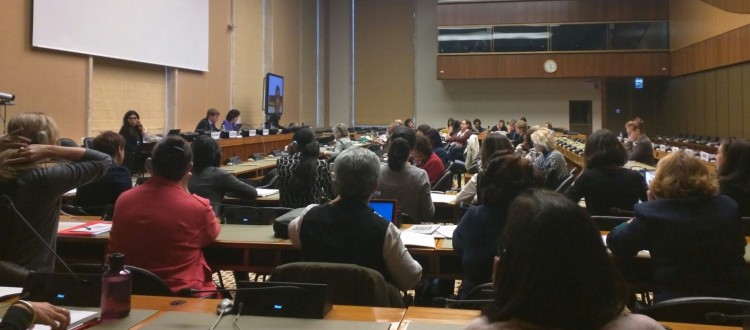
The Committee on the Elimination of Discrimination against Women (CEDAW) is a body of independent United Nations experts that oversees the implementation of the Convention on the Elimination of All Forms of Discrimination against Women (CEDAW).
“Below, we offer a google translate version of the original article in Spanish. This translation may not be accurate but serves as a general presentation of the article. For more accurate information, please switch to the Spanish version of the website. In addition, feel free to directly contact in English the person mentioned at the bottom of this article with regards to this topic.”
All States parties are required to submit periodic reports to the Committee to account for compliance with international obligations undertaken with the signature of CEDAW. According to their experience and work, the organizations in each country can present a “shadow report” to give an account of the reality of women in the State, so that the Committee has the necessary tools for the elaboration of the Recommendations you have to make.
Following the completion of Argentina’s review process, the CEDAW Committee, at its 65th meeting, issued its “Concluding Observations“, reflecting the work of civil society organizations expressed through the shadow reports presented to the Committee . FUNDEPS participated in three reports, whose contributions were considered in order to achieve progress in the effective guarantee for the exercise of the human rights of Argentine women.
Media and symbolic violence
In conjunction with the Civil Association Communicating Equality, we developed a special document for the Committee based on our report “Gender Violence and Public Communication Policies“. In consideration of our observations, the CEDAW Committee recommended to our country, in paragraphs 18 and 19, “Stereotypes and harmful practices”:
“(A) Intensify its efforts to dispel the sexist attitudes and stereotypes of the state public authorities in the three branches of government;
B) Adopt a comprehensive strategy aimed at women, men and girls to overcome the culture of machismo and discriminatory stereotypes about the roles and responsibilities of women and men in the family and in society. Ensure that this strategy also addresses intersectoral forms of discrimination against women as defined in the Committee’s General Recommendation No. 28 (2010) on “Fundamental obligations of States Parties under article 2 of the Convention on the Elimination of All Forms of Discrimination against Women” Forms of discrimination against women “, paragraph 18;
C) Strengthen cooperation with civil society organizations in the fight against discriminatory stereotypes through awareness campaigns such as the “#Ni Una Menos” campaign; Y
D) To amend Act No. 26.522 (2009) on audiovisual media services, in order to provide the Public Defender with the power to sanction violations of provisions to regulate gender stereotypes and sexism in the media”
Women’s Health: Tobacco Use
Our work teams also participated in and supported the elaboration of the report presented by the Inter-American Heart Foundation, FEIM and other organizations, on public policies on tobacco control that currently allow the development of industry strategies aimed especially at women. With regard to what was requested in the “shadow report”, the Committee expressed concern about “high tobacco consumption among girls compared to children”. As a result, he recommended to Argentina in paragraph 35:
“(G) Ratify the Framework Convention of the World Health Organization for Tobacco Control, reduce high tobacco use among adolescents, particularly girls, and address the health consequences.”
Rural and indigenous women
In connection with the report by the Plural Foundation, in a coalition with Fundapaz, Redes Chaco and others, on the access to natural resources by rural women and peasants in the Gran Chaco Americano, which was endorsed by FUNDEPS, the Committee took several points And made several recommendations to Argentina in its sections 38 to 41 on rural and indigenous women, of which we can highlight:
“(A) Design specific programs aimed at ensuring sustainable development and combating the poverty situations faced by rural women, through the allocation of specific resources, employment opportunities, social protection measures and specific programs for women’s education Rural (…)
C) Adopt policies to prevent forced eviction and prevent violence, stigmatization and attacks against rural women in the context of large-scale economic development projects; Y
(D) Ensure that rural women are represented in decision-making processes at all levels of the agricultural sector, including those on disaster risk reduction, post-disaster management and climate change ( …)
A) Take measures to formally recognize land tenure and ownership of indigenous women and promote dialogue at the community level to eliminate discriminatory norms and customs that limit indigenous women’s property rights over land;
C) Ensure that indigenous women have adequate access to safe and affordable water for personal and domestic uses, as well as for irrigation;
D) To examine the current negligent handling of complaints about harmful pesticides, fertilizers and the use of agrochemicals submitted by indigenous women to the Ministry of Health, and to ensure that such cases are resolved in a timely and appropriate manner in accordance with the general recommendations Of the Committee. Recommendation No. 34 (2015) on the rights of rural women; y
E) Establish a mandatory and effective mechanism for consultation and benefit-sharing to obtain the free, prior and informed consent of indigenous women in relation to the use of their natural resources and land. ” From the recommendations made by the Committee, it is only to be expected that the Argentine State will take the necessary measures to guarantee the human rights of women and their effective fulfillment, something in which we will be working together with other organizations of civil society.”
Clarification: The translation of the fragments of the “Final Observations” is of own authorship.
More information
- UN takes recommendations from the Report presented by Plurals and members of ILC Argentina, Plural Foundation.
- The CEDAW Committee recommended that Argentina ratify the Framework Convention on Tobacco Control to protect women from smoking, FIC Argentina.
- FUNDEPS presented report at the 65th session of the United Nations CEDAW Committee, FUNDEPS
Contact
Virginia Pedraza, vir.pedraza@fundeps.org